We are a forward-thinking design studio dedicated to making places that connect and resonate with people.
We are a forward-thinking design studio dedicated to making places that connect and resonate with people.


33 Cavendish Square:
OXFORD STREET, LONDON
Landmark mixed-use scheme
"Matter Space Soul is working with the 33 Cavendish Square design team to create spaces that enhance health and wellbeing, nurture a sense of community and belonging, create vibrant and inclusive places and build a strong sense of place and identity.
Matter Space Soul takes a “compassionate places” approach integrating neuroarchitecture research and cross-disciplinary methods into design projects."
BERKELEY ESTATE ASSET MANAGEMENT - DEVELOPER CLIENT
OVERVIEW
33 Cavendish Square is a transformational mixed-use landmark development on Oxford Street, London, combining culture, commerce and community. The scheme is for the redevelopment of a whole city block, approximately 90,000 sqm including a 21 storey tower, office space, retail and a new cultural center. The proposals received planning permission from Westminster City Council in December 2025.
MATTER SPACE SOUL was commissioned by Berkeley Estate Asset Management for the specialist areas of Human-centric Design, Neuroarchitecture and Urban Strategy to support shaping the scheme for human and social wellbeing.
The impacts and benefits of the scheme aim to address the needs of both the direct users alongside the wider neighbourhood, covering health, sociability, inclusivity, economic vitality, ecological impacts, place identity and belonging.
Core brief includes transforming the building and rejuvenating Oxford Street through:
-
World class retail - New, highly-flexible, flagship retail will provide space for world-class brands on Oxford Street – the nation’s High Street.
-
Culture at the centre - A dedicated space at the ground and first floor will be reserve for a new cultural destination. This will sit at the heart of the development creating a vibrant mixed-use destination
-
Grade A office space - Best in class new, and newly refurbished, office space will be designed with health and sustainability at it’s core.
MSS Scope: Human-centric Design, Neuroarchitecture & Urban Strategy
Location and date: London, 2023 - ongoing
Client: Berkeley Estate Asset Management (BEAM)
Architects: Kohn Pederson Fox
Landscape architects: SpaceHub
Size: Approximately 90,000m2


Image credits:
-
Visualisations - KPF and SpaceHub
-
Indicative sketches and diagrams - MATTER SPACE SOUL
HUMAN EXPERIENCE & IMPACTS
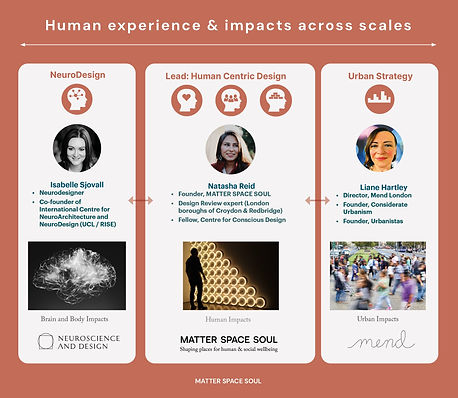

The built environment has profound impacts on human health, social sustainability and people’s quality of life. It can influence wellbeing, performance, behaviours and emotions.
Our specialist team brings together expertise across people’s experience of places to focus on the potential human, social and urban impacts of the scheme at 33 Cavendish Square. We develop human-centric design strategies that bring cutting-edge practices to this forward-thinking development across different scales:
-
Human impacts – Holistic effects of places on people, across health, social wellbeing, urban and cultural vitality, inclusivity and sense of place to make successful destinations.
-
Brain & body impacts – How architecture and design affect humans psychologically and physiologically to maximise wellbeing, attractiveness and appeal.
-
Urban impacts – Considering the strategic scale of this mixed-use destination to reinforce Oxford Street’s revival as a globally relevant, locally resonant place.
The MATTER SPACE SOUL interdisciplinary team for this project includes two collaborating specialists working with project lead Natasha Reid:
Neuroscience & Design – Isabelle Sjovall is a brain researcher, Neurodesigner, and co-founder of the new International Centre for Neuroarchitecture and Neurodesign by UCL and the Research Institutes of Sweden.
Mend London – Liane Hartley has a consultancy focused on social sustainability and care-based “Considerate Urbanism”.
DESIGN STRATEGY CONCEPT
The human-centric design strategies for the development seek to create positive outcomes at multiple levels and embed this into the scheme DNA; from the individual user experience within its walls to the collective identity of the wider district.
The overall strategic concept is creating an urban ecosystem that takes an in-depth and comprehensive Biophilic Design approach. This can create multiple benefits across different areas; from supporting user’s mental health, creativity, sociability and productivity; to the ecological and sustainability benefits of integrating nature and natural materials.
The human-centric design strategy uses in-depth and comprehensive Neuroarchitecture methods to implement cutting-edge innovation and research into this forward-thinking development.
Socio-Economic Impacts
Designing for health, social connectedness, place identity, and for inclusivity can lead to socio-economic benefits, such as:
-
Increased workplace productivity/economic output
-
Savings to the NHS; and
-
Increased spending in the local economy.
The strategies consider how the development can play a pivotal role in shaping the future of Oxford Street, contributing to a holistic, human-centred, and vibrant urban revival.


Image credits: Indicative sketches and diagrams - MATTER SPACE SOUL


